

A data-driven look at how Britain’s 5.5 million small and medium-sized businesses approach search engine optimisation — budgets, barriers, adoption rates, and what the numbers actually tell us.
What the data shows at a glance
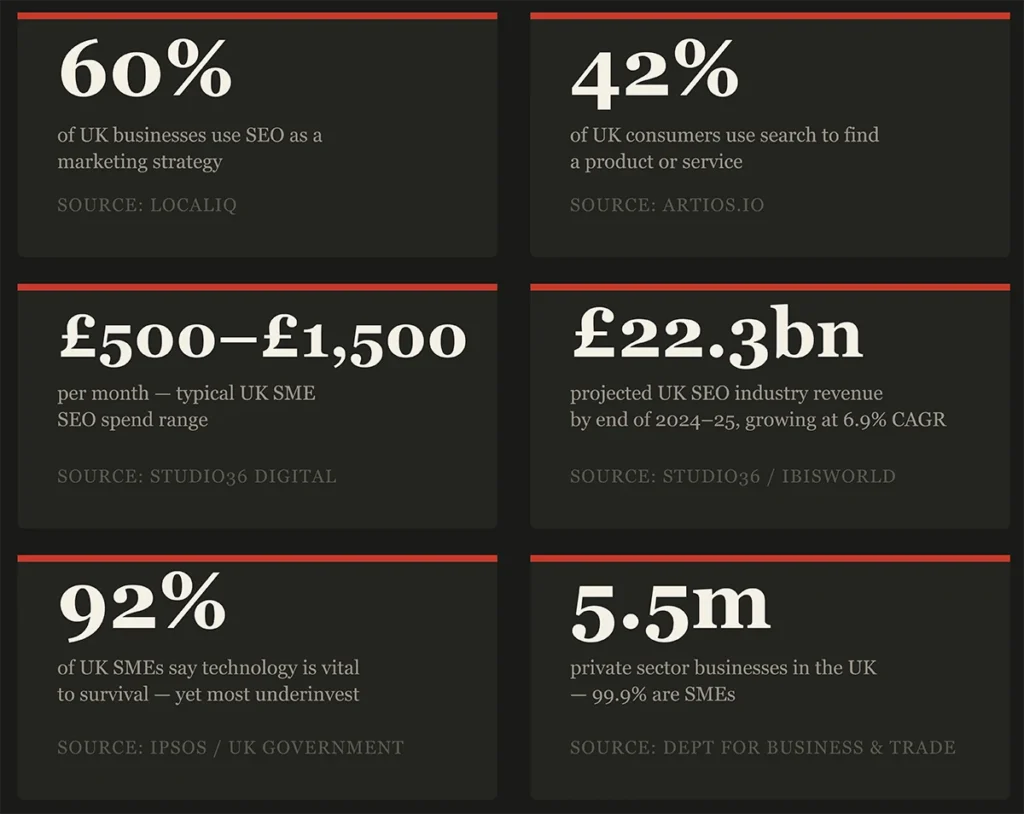
The Scale of the Playing Field
Before we dig into how UK SMEs approach SEO, it helps to understand the landscape they’re operating in. According to the Department for Business and Trade, there are approximately 5.5 million private sector businesses in the UK — a 3.5% increase on the previous year. Of those, 99.9% are classed as SMEs.
That number matters. SMEs are the backbone of the British economy, accounting for roughly 60% of total private sector employment. And yet they generate only 51% of total turnover — a persistent productivity gap that better digital visibility, and specifically SEO, could help to close.
74%
Sole traders and businesses with no employees make up 74% of all UK SMEs. These micro-businesses face the tightest margins and are the most likely to stall on SEO investment, which makes the 60% adoption headline even more interesting when you consider who is actually behind it.
A business with no employees and tight margins is making very different decisions about search visibility than a 50-person company with a proper marketing budget. Any honest look at UK SME SEO behaviour has to account for that fragmentation.

How Many UK SMEs Actually Use SEO?
The headline that 60% of UK businesses use SEO as a marketing strategy gets cited a lot, but it deserves some unpacking. That figure comes from LocaliQ research and refers broadly to “businesses,” which includes larger organisations with dedicated digital marketing teams.
Filter down to genuinely small businesses, those with fewer than 10 employees and adoption rates are meaningfully lower. The barriers are well documented: tight budgets, a shortage of in-house skills, not knowing where to start, and the feeling that SEO is something their bigger competitors do.
“While small businesses are slowly becoming more aware of the importance and benefits of SEO, more agencies might consider introducing low-cost options and packages aimed at SMEs.”
Artios.io, SEO Statistics
The gap between awareness and action is a consistent theme across the data. Most UK SMEs understand that search visibility matters. Turning that understanding into consistent, properly funded activity is where the majority get stuck.
The demand signal is hard to ignore
The consumer-side case for SEO is pretty compelling. According to Artios.io research, 42% of UK consumers use search engines when looking for a product or service, more than double the number who turn to social media, and more than four times those who respond to TV advertising.
42%
of UK consumers use search engines when looking for a product or service. That’s more than double those who use social media. If your business isn’t showing up in search, you’re invisible to nearly half your potential customers at the exact moment they want to buy.
For any UK SME wondering whether SEO is worth the investment, that stat alone is worth sitting with. Customers are searching. The question is whether your business is there when they do.

What UK SMEs Are Spending on SEO
Budget is where theory meets reality. The data on UK SME SEO spend paints a fairly consistent picture across multiple sources.
£0 to £500/month
DIY tools, occasional freelancer, Google Business Profile basics
£500 to £1,500/month
Freelancer or small agency retainer; content and on-page work
£1,500 to £5,000/month
Agency retainer; technical SEO, link building and reporting
£5,000+/month
Full-service agency; content strategy, PR links, GEO
Studio36 Digital’s research confirms that most UK SMEs spend between £500 and £1,500 per month — a range that tries to balance affordability with the ongoing work of building an online presence. Whitehat SEO’s benchmarks place the realistic B2B SME investment at £1,500 to £5,000 monthly for genuine strategic work, rather than template-based solutions.
The retainer model is the dominant pricing structure. Research from GoodFirms found that 60% of companies opted for retainer arrangements over other pricing models — a preference driven by the long-term nature of SEO results and the need for consistent activity rather than one-off projects.
The ROI case is strong — if you can be patient
One reason SMEs hesitate on SEO investment is the gap between spend and return. Unlike paid advertising, which can generate leads within days, SEO compounds over months and years. For cash-conscious small businesses, that timeline is a genuine obstacle.
The long-term data, however, makes a strong case. Whitehat SEO’s analysis of UK B2B companies puts the median three-year ROI from SEO at 748%, compared to roughly 200% for pay-per-click advertising. The catch is that reaching that return requires sustained investment and patience — two things that are easier for a 50-person business than a five-person one.

The Barriers UK SMEs Face
Understanding why so many UK SMEs under-invest in SEO means looking at the structural barriers, not just the attitude. The research consistently points to four recurring obstacles.
1. Tight budgets
Profitability among UK SMEs has recovered to pre-pandemic levels, with 78% reporting a profit or surplus in recent years — but the median reported profit was just £13,000. With margins that thin, a monthly SEO retainer of even £500 is a real commitment, sitting alongside payroll, premises and supplier costs.
2. Skills shortages and digital knowledge gaps
The UK Government’s SME Digital Adoption Taskforce identified lack of information, guidance and bespoke advice as a key barrier to technology adoption. SEO is particularly opaque for non-specialists: the terminology is jargon-heavy, the goalposts shift with every algorithm update, and results are often invisible until something goes wrong.
“92% of UK SMEs think technology is vital to their survival — yet they planned to increase technology investment by just 13%, below the European average of 18%.”
Ipsos / UK Government SME Technology Adoption Report
3. Technology adoption inertia
Research on digital transformation in SME marketing identifies “technology adoption inertia” as a distinct barrier separate from cost and skills. This is the tendency to stick with what already works (word of mouth, existing clients, paid social) rather than invest in a channel that requires setup time and expertise before it delivers.
4. A constantly moving target
Search engine algorithms change all the time. The rise of Google’s AI Overviews, the emergence of Generative Engine Optimisation (GEO) alongside traditional SEO, and the declining predictability of ranking signals have made the channel feel riskier than it once did. For a small business owner already stretched thin, keeping pace with these shifts can feel unrealistic.
NOTE: The UK currently ranks 6th in digital adoption among G7 countries. The Government’s stated ambition is for UK SMEs to become the most digitally capable in the G7 by 2035. That gap between where things stand and where they’re trying to get to is one reason SEO-related policy discussion has picked up in recent years.

Where UK SMEs Are Focusing Their SEO Efforts
For UK SMEs that are actively investing in SEO, where are they putting their energy? The data points to a few clear priorities.
Local SEO is the natural starting point
For most UK small businesses, service providers, retailers, tradespeople, hospitality businesses, local SEO represents the highest-return starting point. The numbers back this up: 46% of all Google searches carry local intent, and 78% of local mobile searches result in an offline purchase. Google Business Profile optimisation is often the first SEO activity a small business takes on — and for many, it stays the most impactful.
Content and on-page SEO absorb the most budget
Within agency retainers, content creation and on-page optimisation take up the largest share of SME SEO budgets. That’s partly practical — content produces compounding returns — and partly a reflection of where SMEs feel they have the most direct control. Technical SEO, despite being important, tends to get pushed back until something noticeably breaks.
Link building remains the toughest part
Globally, 41% of marketers say link building is the hardest part of SEO — and that holds true for UK SMEs. The resources needed to earn quality inbound links consistently (through original research, PR, partnerships or digital PR campaigns) are simply beyond the reach of most small businesses on minimal retainers.

The Industry Behind the Industry
It’s worth placing UK SME SEO activity within the broader SEO services market. Approximately 33,167 businesses operate in the UK’s SEO and internet marketing consultancy sector, employing around 89,556 people. Projected industry revenue is expected to reach £22.3 billion by the end of the 2024 to 25 period a compound annual growth rate of 6.9%.
Google remains the dominant force, holding a 90.15% share of the UK search engine market, meaning that for almost all practical purposes, UK SEO strategy is Google strategy. Bing accounts for roughly 3.3%, relevant for some B2B audiences and AI-adjacent search products, but not the primary battleground.
£22.3bn
Projected UK SEO industry revenue by end of the 2024 to 25 period. Growing at a 6.9% CAGR, the sector that helps businesses get found online is itself one of the UK’s significant growth industries, a reflection of how central search has become to commercial activity at every scale.

What This Means in Practice
Stepping back from the data, the picture is fairly clear. Most UK small businesses understand, in principle, that search visibility matters. A significant minority, probably those that are more commercially active and digitally confident, are investing meaningfully in it. The rest are either doing the bare minimum (claiming a Google Business Profile, hoping for the best) or nothing at all.
The gap between the 60% adoption headline and what’s actually happening on the ground comes down to structural barriers: thin margins, limited expertise, and a channel that rewards patience over the short-term thinking that cash-conscious businesses are often pushed into.
The opportunity that creates for businesses that do invest consistently is real. In a market where a meaningful number of competitors are doing very little, the bar for a visible, well-maintained organic search presence is lower than it might look.
The businesses that will get the most from SEO over the next few years are likely those that start now, not because it’s easy, but because the compounding nature of the channel rewards those who stay the course.
“Organic search produced an average of 33% of overall website traffic across seven key industries — and that traffic costs nothing to maintain once the rankings are earned.“
Conductor, State of SEO Survey

AI Is Changing the Rules and Most SMEs Are Playing Catch-Up
If the traditional barriers to SEO felt challenging enough, artificial intelligence has introduced a new layer of complexity that many small business owners are still trying to get to grips with.
Google’s AI Overviews now appear at the top of search results for a growing number of queries, answering questions directly without the user needing to click through to a website. For SMEs that have invested in content to capture that organic traffic, it’s a shift worth paying close attention to.
Alongside this, Generative Engine Optimisation (GEO) is emerging as a discipline in its own right. This refers to the practice of optimising content so it gets referenced or surfaced by AI-powered tools like ChatGPT, Google Gemini and similar platforms. It builds on the foundations of traditional SEO, quality content, strong authority, clear structure, but the way results are presented and the signals that drive visibility are evolving quickly.
For larger businesses with dedicated marketing teams, adapting to these changes is an operational challenge. For most SMEs, it’s an entirely new vocabulary on top of an already complex channel.
“AI-powered search is changing the way people find information online. For SMEs already stretching their resources to cover basic SEO, keeping pace with these developments is one of the most pressing digital challenges of the next few years.“
The good news is that the fundamentals of good SEO — helpful, well-written content; a technically sound website; a clear local SEO presence — remain the right foundation whether you’re optimising for traditional search or AI-driven results. The businesses that get those basics right will be better placed to adapt as the landscape continues to shift.
If you’re a UK SME wondering where to start with SEO in an AI-influenced search landscape, we can help. Get in touch with us to talk through what’s right for your business.
 Joanna Tracey