

Every few years, somebody in marketing declares that SEO is dead. It survived the rise of social media, the mobile shift, voice search and about a dozen Google updates with cute animal names. Now it is AI’s turn to be cast as the villain of the story.
Except the data tells a rather different tale. Search is not disappearing. It is evolving, and rather quickly, into something broader. If you run a small or medium business, understanding that distinction is what separates quietly losing visibility from quietly winning it.
This guide walks through why the “SEO is dying” narrative took hold, what the actual numbers show, how AI is reshaping the search experience, and what your business should be doing about it. Grab a cup of tea. This one is worth the read.
Why everyone thinks SEO is dying
The panic is understandable. ChatGPT, Gemini, Perplexity and Google’s own AI Overviews now answer plenty of questions directly on the results page, without a single click through to a website. Marketers watched click through rates dip and jumped straight to the worst conclusion.
Add to that a genuine rise in AI powered chat assistants, and it is easy to see why “SEO is dead” makes for such a tempting headline. It is dramatic. It gets shared. It is also, according to the numbers, mostly wrong.
Google itself addressed the question directly in its official guidance for site owners, published through Google Search Central. Asked plainly whether SEO still matters for generative AI search, Google’s answer was refreshingly short: “In short, yes.” The company explained that its AI features are built directly on top of its existing Search ranking and quality systems, meaning the sites that were doing SEO properly beforehand are the ones now surfacing inside AI answers too.
So why does the death of SEO keep trending? Mostly because change is noisy and continuity is boring. A shrinking click through rate on informational queries makes for a better LinkedIn post than “the fundamentals still work, just with an extra layer on top.”

What the data actually shows
Let us deal in facts rather than vibes.
- Google still processes an estimated 8.5 billion searches every single day, according to Google search usage data compiled by Coalition Technologies. That is roughly 99,000 searches every second, day and night, weekends included.
- Organic search typically drives around 53 per cent of all trackable website traffic across industries, comfortably ahead of paid search, direct visits, social media and referrals combined, per research summarised by BizIQ’s 2026 SEO statistics roundup.
- The overwhelming majority of users never bother going past the first page of Google. Some studies put the figure at under one per cent clicking through to page two, though a commonly cited rule of thumb is that around three quarters of searchers stop looking once they hit the bottom of page one.
- The first organic result typically receives somewhere between a quarter and two fifths of all clicks on a search page, depending on the query and whether an AI Overview appears above it.
- AI search usage is growing at real pace. Even so, Google still handles somewhere between 80 and 90 per cent of total global search volume, with AI platforms currently taking a meaningful but distinctly smaller slice, concentrated mostly in research heavy, informational queries, according to Presenc AI’s 2026 market share research.
- Businesses that publish genuinely helpful content on a consistent basis generate far more indexed pages, and therefore far more opportunities to rank, than those who post once a quarter and hope for the best.
Here is that market share picture visually.
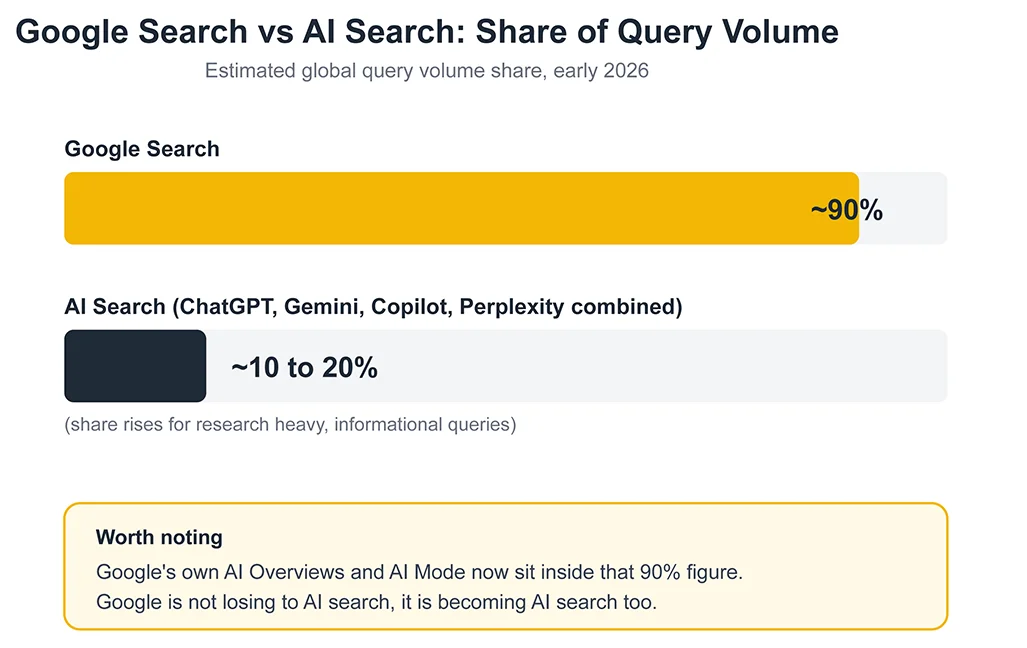
Notice something important in that graphic. Google’s own AI Overviews and AI Mode sit inside its 90 per cent, not outside it. Google is not losing a war to AI search. It is fighting a war on two fronts and currently winning both.

How AI is changing search
AI is not replacing the search box, it is changing what happens either side of it.
Before the click.
Google’s AI Overviews now summarise answers to a growing share of informational queries, sitting above the traditional blue links. Some studies estimate they appear on somewhere between 13 and 30 per cent of US searches, depending on query type, with far higher rates for long tail, question based searches. This is genuinely reshaping click behaviour, particularly for simple factual questions that never needed a full article in the first place.
During the research phase.
People increasingly bounce between Google, ChatGPT and Perplexity while researching a purchase or decision, especially for anything complex, expensive or unfamiliar. Traffic that arrives via an AI citation tends to convert at a notably higher rate than average organic traffic, because by the time someone clicks through from an AI answer, they are usually much further along in their decision.
Behind the scenes.
Google’s core ranking systems themselves are increasingly powered by machine learning, from RankBrain and BERT through to today’s more advanced language models. AI has been quietly running the show inside Google for the best part of a decade. What is new is that AI now also writes some of the visible summary text on the results page.
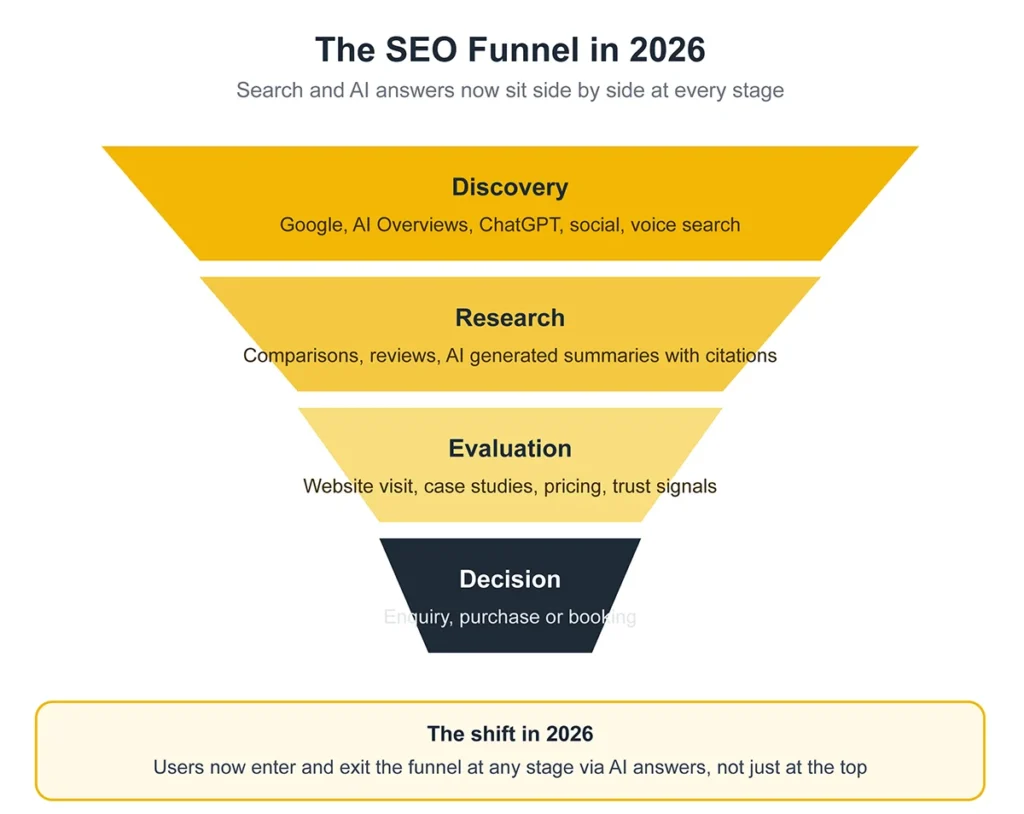
Put simply, AI has added a new layer to the discovery journey. It has not removed any of the layers underneath.
What Google says
It is worth taking Google’s own guidance seriously here, since Google controls the surface everyone is trying to optimise for.
In its formal documentation on optimising for generative AI features, Google confirmed that AEO (answer engine optimisation) and GEO (generative engine optimisation) are, in its own words, still SEO. The guidance also busts a few myths that had been doing the rounds, including the idea that you need a special llms.txt file, that you must chop your content into oddly shaped chunks for AI to digest, or that adding certain schema types guarantees a citation inside an AI Overview. According to reporting from CMSWire on Google’s AI search playbook, none of that is required. What is required is largely what has always been required: genuinely useful, well structured, technically sound content that demonstrates real experience and expertise.
Google has also been clear that citations inside AI Overviews function as real links, and that these links do send meaningful traffic back to websites, even if the volume per click is lower than a traditional blue link result. AI Overviews are designed to point users towards the web, not to keep them permanently on Google’s own page.
Ready to stop guessing and start ranking?
That is exactly what our SEO service for small businesses is built around. No jargon, no long contracts, just a clear plan to get your website found, by Google and by the AI answers increasingly sitting above it.
The biggest ranking factors today
Rankings in 2026 are decided by a blend of long standing fundamentals and a few newer considerations layered on top.
- Content that demonstrates real experience. Google’s E E A T framework (Experience, Expertise, Authoritativeness, Trustworthiness) still governs how content is judged, and it has only become more important as AI systems try to work out which sources to trust.
- Backlinks from relevant, credible sites. Referring domains remain one of the strongest measurable ranking signals, and top ranking pages typically carry considerably more quality backlinks than pages sitting lower down the results.
- Technical health. Crawlability, fast loading speed, mobile usability and clean site structure remain table stakes. If Google cannot render your page properly, no amount of clever writing will save you.
- Search intent match. Content genuinely needs to answer the question being asked, in the format the searcher expects, whether that is a quick definition, a detailed guide or a comparison table.
- Freshness and depth. Thorough, well maintained content that gets updated over time tends to outperform content that was published once and forgotten.
- Structured, citable answers. Clear headings, direct answers near the top of a section and well organised information all improve your odds of being picked up inside an AI generated summary, on Google or elsewhere.
None of this is radically new. It is the same list SEO professionals would have written five years ago, with a slightly sharper focus on trust and structure.

What businesses should stop doing
A few habits genuinely deserve retiring in 2026.
- Stop chasing keyword volume for its own sake. Ranking for a term nobody with buying intent ever searches is a vanity metric, not a growth strategy.
- Stop publishing thin, templated content purely to tick a box. Search Engine Land style survey data cited across the industry shows that a striking proportion of published pages get zero organic traffic at all, largely because they never earned the trust or relevance to rank.
- Stop treating link building as a numbers game. A handful of genuinely relevant, high quality links from respected sites will do more for you than a hundred low value directory listings ever will.
- Stop ignoring technical SEO. A beautifully written page trapped behind a slow, broken or poorly indexed site is a page nobody will ever read.
- Stop panicking every time a new acronym appears. GEO, AEO and whatever comes next are largely rebrandings of good SEO practice, not entirely new disciplines requiring an entirely new budget line.

What businesses should invest in instead
If you want your budget to work harder in 2026, direct it here.
- Genuinely expert content, written by, or at least reviewed by, people who actually know the subject. This is one of the clearest ways to signal E E A T to both Google and AI systems.
- A proper technical foundation, including strong page speed, clean structure and mobile friendliness. Our technical SEO service exists precisely because this groundwork tends to get skipped, and it quietly undermines everything built on top of it.
- On page optimisation that answers real questions clearly, rather than burying the answer under three paragraphs of preamble. Have a look at our on page SEO guidance for a sense of what good looks like.
- Relevant, earned backlinks, built through genuine relationships, guest contributions and content worth referencing. Our link building service focuses on quality over quantity for exactly this reason.
- Local SEO, if you serve a specific area, since local and “near me” style searches remain highly resistant to AI disruption. People still want a real business, nearby, with real reviews. See our local SEO support for more.
- A joined up marketing strategy, so SEO is not operating in isolation from your wider content, ads and social activity. Our marketing strategy and planning service is designed to pull all of that together.
✅ Real examples
A specialist B2B software business we worked with was convinced their organic traffic was in permanent decline because of AI search. A closer look at their analytics showed the real story: overall visits had held steady, but a growing share of new enquiries were arriving from users who had first encountered the brand through an AI generated answer citing one of their guides, then searched the brand name directly on Google afterwards. Traffic was not vanishing, it was simply taking a slightly longer, two step route to the same destination.
Elsewhere, our case studies show small businesses achieving top three rankings across multiple markets and a meaningful jump in top ten organic keywords, built on the same unglamorous foundations covered above: solid technical SEO, genuinely useful content and quality backlinks, rather than any AI specific trickery.
The pattern holds across most sectors. Businesses publishing consistent, genuinely useful content keep showing up, in Google’s blue links and increasingly inside AI generated answers too, simply because that content is trustworthy enough to be cited.


A quick look back, to understand where we are heading
Search has never stood still, which is precisely why the current AI moment feels less like an ending and more like the next entry on a long list.
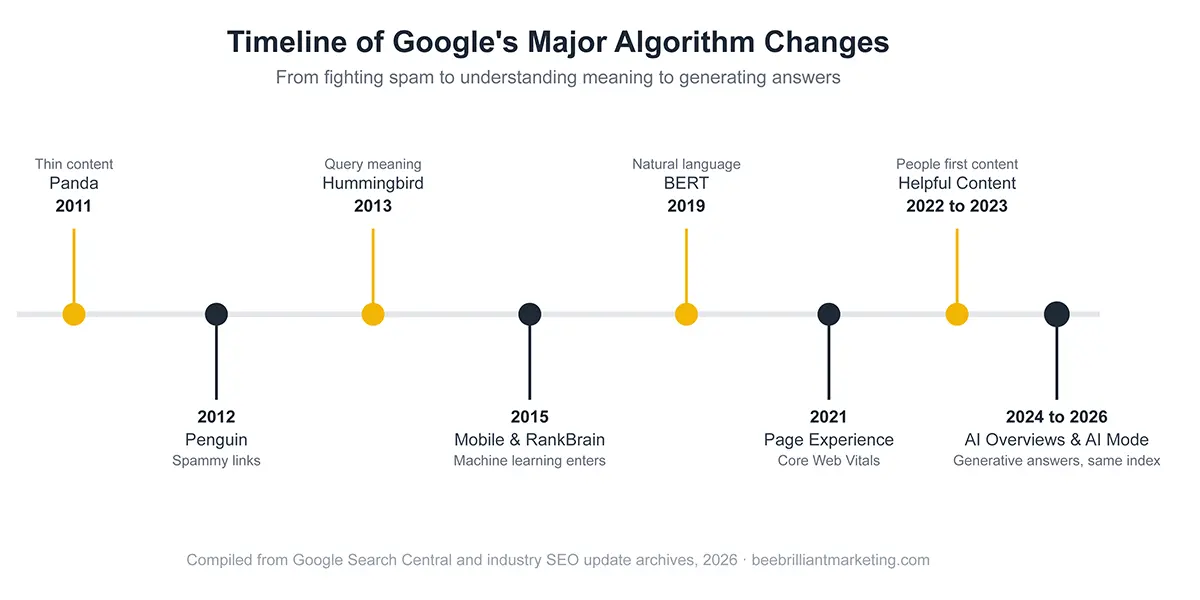
Every single one of those updates was met with its own round of “SEO is dead” headlines at the time. Panda supposedly killed content farms and, by extension, content marketing itself. Penguin supposedly killed link building. Mobile first indexing supposedly killed desktop sites. SEO adapted every time, because the underlying goal, matching genuinely useful content with the people searching for it, never actually went away.
SEO is not dying. It is maturing, again, the way it always has whenever a genuinely significant shift arrives. The businesses that thrive through this next phase will be the same ones who have always thrived through change: the ones publishing genuinely helpful content, built on solid technical foundations, backed by real expertise and earned trust, rather than the ones chasing whichever acronym happens to be trending this quarter.
AI is simply raising the bar for what counts as citable, trustworthy content, then the smart move is not to abandon SEO. It is to get considerably better at it.
FAQs
No. Organic search still drives roughly half of all trackable website traffic, and Google still handles the vast majority of global search volume. AI has changed some behaviour around clicks, particularly for simple informational queries, but it has not replaced search as a discovery channel.
No, and Google’s own guidance backs this up directly. AI Overviews and AI Mode run on the same underlying ranking and quality systems as traditional search. Solid SEO fundamentals are currently the best available strategy for showing up in both.
Generative engine optimisation and answer engine optimisation both describe optimising content so AI systems can understand, trust and cite it. In practice this overlaps enormously with good SEO: clear structure, genuine expertise, credible sourcing and answers written in plain language.
They can reduce click through rates on simple, single fact queries where the AI answer fully satisfies the searcher. For anything more complex, comparative or commercial, users still tend to click through to compare options properly, particularly when a purchase decision is involved.
Broadly similar timelines to before, typically several months for meaningful movement and considerably longer for competitive terms. Businesses that publish consistently and build technical credibility tend to see compounding results over time rather than a single dramatic spike.
Not fundamentally. Clear, well structured, genuinely helpful content written for real people tends to perform well across both, because both systems are ultimately trying to identify the same thing: content that actually answers the question.
 Joanna Tracey